Molecular biology
  • Home
  • videos
    • Biology
    • Molecular Biology
    • Cell Biology
    • Biochemistry
    • Scientific Animation
    • Others
  • Books
    • Cell and Molecular Biology
    • Biochemistry and Biotechnology
    • Microbiology
    • Immunology
    • Biology
  • Notes
    • Molecular Biology
    • Biochemistry
    • Botechnology
  • Mock Test

Saturday, July 20, 2024

DNA (Deoxyribonucleic Acid) Chapter-6

 July 20, 2024     Molecular biology     No comments   


DNA Mutations:

Overview

A mutation is a change in the nucleotide sequence of DNA. Mutations can occur spontaneously during DNA replication or be induced by environmental factors such as radiation and chemicals. While some mutations are neutral or beneficial, many can be harmful, potentially leading to diseases like cancer.

Types of Mutations

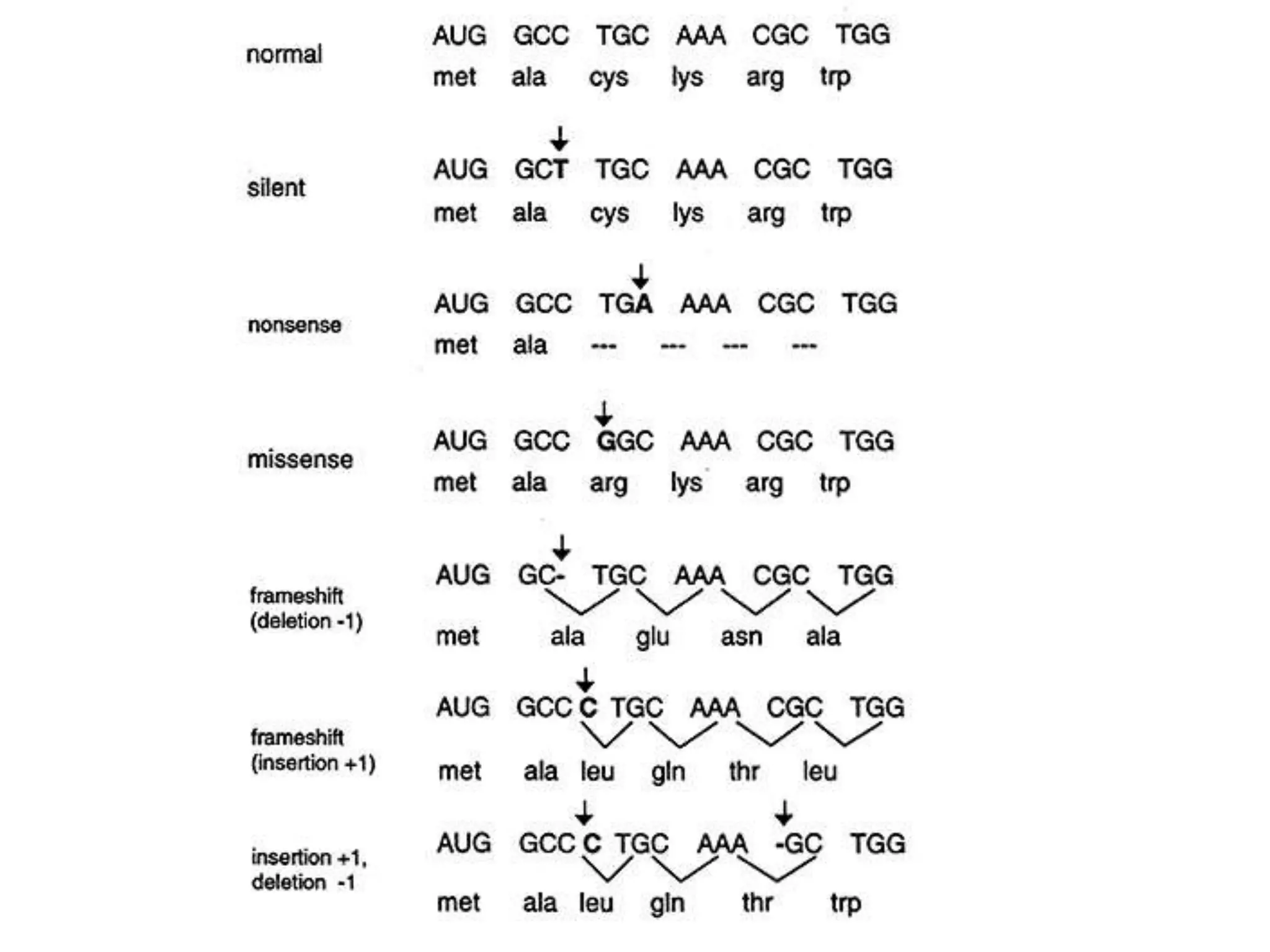
  1. Point Mutations:

    • Silent Mutation: A change in a nucleotide that does not affect the amino acid sequence of a protein due to the redundancy of the genetic code.
    • Missense Mutation: A change in a nucleotide that results in a different amino acid being incorporated into the protein. This can affect protein function.
    • Nonsense Mutation: A change in a nucleotide that converts a codon encoding an amino acid into a stop codon, resulting in a truncated, usually nonfunctional, protein.
  2. Frameshift Mutations:

    • Caused by insertions or deletions of nucleotides that are not in multiples of three, resulting in a shift of the reading frame of the genetic code. This often leads to a completely different and nonfunctional protein.
  3. Insertions and Deletions:

    • Insertion: Addition of one or more nucleotide pairs into the DNA sequence.
    • Deletion: Removal of one or more nucleotide pairs from the DNA sequence.
  4. Chromosomal Mutations:

    • Duplication: A segment of the chromosome is copied and inserted into the genome, resulting in multiple copies of that segment.
    • Deletion: A segment of the chromosome is removed.
    • Inversion: A segment of the chromosome is reversed end to end.
    • Translocation: A segment of one chromosome is moved to another chromosome.
Reference:https://www.slideshare.net/AliaNajiha1/chap-4-mutation#24


Causes of Mutations

  1. Spontaneous Mutations:

    • Occur naturally due to errors in DNA replication, repair, or recombination. The intrinsic error rate of DNA polymerase is a source of spontaneous mutations.
  2. Induced Mutations:

    • Caused by environmental factors known as mutagens:
      • Physical Mutagens: Such as ultraviolet (UV) light and ionizing radiation, which can cause thymine dimers or double-strand breaks.
      • Chemical Mutagens: Such as base analogs, alkylating agents, and intercalating agents, which can alter DNA structure and function.
      • Biological Agents: Such as certain viruses that can integrate into the host genome and cause mutations.

Consequences of Mutations

  1. Beneficial Mutations:

    • Provide a selective advantage to the organism, contributing to evolutionary adaptation.
  2. Neutral Mutations:

    • Have no significant effect on the organism’s fitness and may persist in the population without being selected for or against.
  3. Harmful Mutations:

    • Can lead to genetic disorders, cancers, and other diseases by disrupting normal gene function or regulation.

DNA Repair Mechanisms

  1. Direct Repair:

    • Fixes specific types of damage without removing the affected bases. For example, photolyase repairs UV-induced thymine dimers.
  2. Excision Repair:

    • Base Excision Repair (BER): Removes damaged bases and replaces them with the correct ones.
    • Nucleotide Excision Repair (NER): Removes bulky DNA lesions, such as thymine dimers, and replaces them with the correct nucleotides.
  3. Mismatch Repair (MMR):

    • Corrects errors that escape proofreading during DNA replication, recognizing and repairing mismatched bases.
  4. Double-Strand Break Repair:

    • Homologous Recombination (HR): Uses a sister chromatid as a template for accurate repair.
    • Non-Homologous End Joining (NHEJ): Directly joins the broken ends of DNA, which can result in loss or gain of nucleotides at the break site.
Reference:https://microbenotes.com/dna-damage-and-repair/


Please, write your suggetions in comment section.

Follow our blogs for more updates and protocols: https://iammolecularbiologist.blogspot.com/  

Follow us on WhatsApp: https://chat.whatsapp.com/I30OdffWlJhGABXsTmKo95


  • Share This:  
  •  WhatsApp
  •  Facebook
  •  Twitter
  •  Google+
  •  Stumble
  •  Digg
Email ThisBlogThis!Share to XShare to Facebook
Newer Post Older Post Home

0 Comments:

Post a Comment

Followers

Popular Posts

  • Basic Molecular Biology chapter -3
    Principles of gene regulation: Introduction to Gene Regulation Gene regulation is a critical process by which cells control the expression o...
  • Protein Chapter-1
    1. Introduction to Proteins Definition : Proteins are macromolecules consisting of one or more long chains of amino acid residues. Structure...
  • DNA (Deoxyribonucleic Acid) Chapter-5
    DNA Replication 1.  Detailed Process of DNA Replication DNA replication is the process by which a cell duplicates its DNA, ensuring that eac...
  • DNA (Deoxyribonucleic Acid) Chapter-7
      DNA Packaging:  DNA packaging is a highly regulated process that enables the compaction of genetic material to fit within the confines of ...

Categories

  • Biochemistry
  • MCQ
  • Mock test
  • Molecular biology
  • Molecular biology technology
  • Science

Blog Archive

  • ▼  2024 (30)
    • ►  December (1)
    • ►  August (3)
    • ▼  July (26)
      • Structure and Function of RNA MCQ
      • Mock Test on Protein structure
      • RNA (Ribonucleic acid) Chapter-3
      • Protein Chapter-3
      • Basic Biochemistry Chapter-1
      • RNA (Ribonucleic acid) Chapter-3
      • Protein Chapter-2
      • Mock Test on DNA Function
      • Mock Test on RNA Function
      • Mock Test on RNA Transcription
      • Mock Test on RNA Structure
      • Protein Chapter-1
      • Mock Test on DNA Mutation
      • RNA (Ribonucleic acid) Chapter-2
      • Mock test on DNA Replication
      • Mock test on DNA structure
      • Structure and Function of DNA MCQ
      • Basic Molecular Biology Chapter-2
      • RNA (Ribonucleic acid) Chapter-1
      • DNA (Deoxyribonucleic Acid) Chapter-6
      • DNA (Deoxyribonucleic Acid) Chapter-5
      • DNA (Deoxyribonucleic Acid) Chapter-4
      • DNA (Deoxyribonucleic Acid) Chapter-3
      • DNA (Deoxyribonucleic Acid) Chapter-2
      • DNA (Deoxyribonucleic Acid) Chapter-1
      • Basic Molecular Biology Chapter-1
  • ►  2022 (3)
    • ►  January (3)

Tags

Biochemistry MCQ Mock test Molecular biology Molecular biology technology Science

Featured post

Basic Molecular Biology chapter -3

Principles of gene regulation: Introduction to Gene Regulation Gene regulation is a critical process by which cells control the expression o...

Popular Posts

  • Basic Molecular Biology chapter -3
    Principles of gene regulation: Introduction to Gene Regulation Gene regulation is a critical process by which cells control the expression o...
  • Protein Chapter-1
    1. Introduction to Proteins Definition : Proteins are macromolecules consisting of one or more long chains of amino acid residues. Structure...

Copyright © Molecular biology | Powered by Blogger
Design by Hardeep Asrani | Blogger Theme by NewBloggerThemes.com | Distributed By Gooyaabi Templates